Showing posts with label PHP Basic. Show all posts

Friday, September 13, 2019

Swapping Two Numbers Without Using Third Variable in PHP

Given two variables a and b, swap two variables without using a third variable.


Method (Using Arithmetic Operators)
The idea is to get a sum in one of the two given numbers. The numbers can then be swapped using the sum and subtraction from sum.


<?php
// PHP Program to swap two numbers without third variable
$a = 25;
$b = 19;

echo "a before swapping : ", $a;
echo "b before swapping : ", $b;

// code to swap numbers

$a = $a + $b; // a becomes 44 now
$b = $a - $b; // b becomes 25 now
$a = $a - $b; // a becomes 19 now

echo "a after swapping : ", $a;
echo "b after swapping : ", $b;
?>

OUTPUT:
a before swapping : 25
b before swapping : 19

a after swapping 19
b after swapping 25

Wednesday, June 26, 2019

echo vs print Statement in PHP

There are two basic ways to get output in PHP:
  • echo
  • print

PHP echo statement

In PHP echo statement is a language construct and not a function, so it can be used without parentheses. But we are allowed to use parentheses with echo statement when we are using more than one arguments with it. The end of the echo statement is identified by the semi-colon (';').
We can use echo to output strings or variables. Below are some of the usage of echo statement in PHP:

Displaying Strings: We can simply use the keyword echo followed by the string to be displayed within quotes. Below example shows how to display strings with PHP:

<?php
echo "Hello, This is echo vs print statement!";
?>

Output: Hello, This is echo vs print statement!

Displaying Strings as multiple arguments: We can pass multiple string arguments to the echo statement instead of a single string argument, separating them by comma (,) operator.

<?php
echo "Hello!", "PHP", "World";
?>

Output: Hello! PHP World

PHP print statement

The PHP print statement is similar to the echo statement and can be used alternative to echo at many times. It is also language construct and so we may not use parentheses: print or print().
Like echo, print statement can also be used to print strings and variables. Below are some examples of using print statement in PHP:

Displaying String of Text: We can display strings with print statement in the same way  as we did with echo statements. The only difference is, we cannot display multiple strings separated by comma(,) with a single print statement.

<?php
print "Hello World!";
?>
Output: Hello World!


Difference Between echo and print Statement

  • echo can accept multiple arguments while print only accepts a single argument
  • echo doesn't have a return value while print always returns 1
  • echo is marginally faster than print


Saturday, April 30, 2016

10 of the best online resources to learn PHP

The best way to learn PHP, or really any other language, is by practising writing code. Pick a simple practice project, implement it, and then pick another one. You don't have to create a beautiful website to practice. Create an ugly website that serves as your sandbox for trying out code.

 You now want to learn about programming in PHP, but where do you start? If you don’t know where to start, here are few great sites to learn PHP programming online for free.

PHP.net

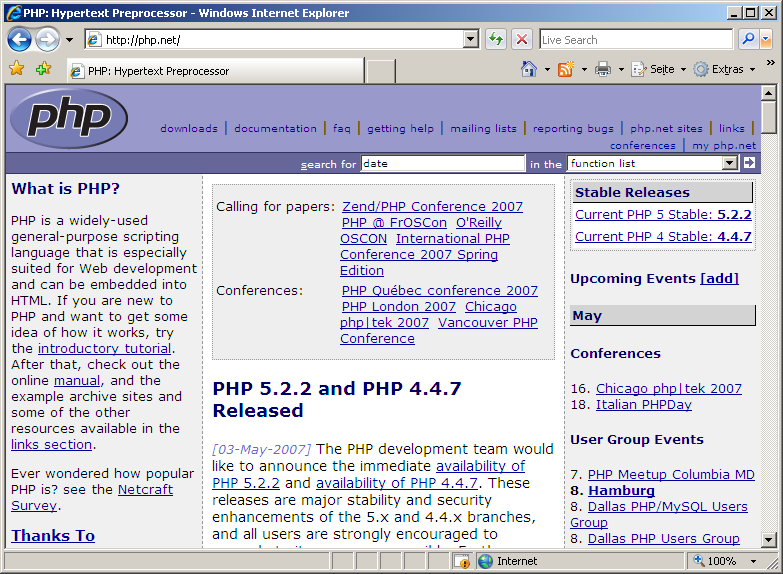
The first and the best place to learn PHP is PHP.net. This is PHP’s official website. This site has everything you need to know about PHP. So when you definitely know that you want to create a website in PHP, start the tutorial and get busy.


Once you have learned the basic concepts to creating a PHP based website, it is time to look at the user manual. Everything you need to know is there. Once you have finished reading, you should now be a PHP expert.

w3 Schools

w3 Schools offers tutorials for programming in PHP and other scripting languages, but we are going to focus on the PHP section.

At w3 Schools, you can learn the basics of PHP such as the syntax, variables, strings, arrays, selection and loop statements, how to use forms and much more. Once you have mastered the basics, you can then go onto the advance stuff such as includes, file uploads, cookies, sessions, and how to send secure emails.


So you think you are done learning? Nice try. We still have heaps more to learn. There is PHP and XML, PHP and AJAX, and PHP and References still to go. Once done and you think you know everything there is to programming in PHP, try the online quiz, then attempt the exam.

PHP: The Right Way

PHP: The Right Way is an easy-to-read, quick reference for PHP popular coding standards, links to authoritative tutorials around the Web and what the contributors consider to be best practices at the present time.

There is no canonical way to use PHP. This website aims to introduce new PHP developers to some topics which they may not discover until it is too late, and aims to give seasoned pros some fresh ideas on those topics they’ve been doing for years without ever reconsidering. This website will also not tell you which tools to use, but instead offer suggestions for multiple options, when possible explaining the differences in approach and use-case.

This is a living document and will continue to be updated with more helpful information and examples as they become available.

Planet PHP 

Planet PHP is the good blog site to learn PHP by expert's experience. so you can subscribe Planet PHP blog.


Stackoverflow.com 

The best website to learn PHP is your own website, seriously. Give yourself a tough project and just google for solutions to any obstacles, there is no better way to learn than pure experience. You will write horrible code, and as fast as a couple days later you'll be able to recognize the horrible mistakes you made a week earlier, but never stop and never feel confident.


The first year at least will consist almost entirely of this incremental learning process, even when you feel you've got it all down. stackoverflow.com is the best website to learn by practice and fix your own practical issue.


PHPBuddy

PHPBuddy contains articles and tutorials on how to do basic PHP tasks such as how to work with Sessions, and encrypting and protecting your PHP code, so it is worth checking out.


PHP Fundamentals - Tuts+ Course

Envato Tuts+ offers video courses and written tutorials to help you learn creative skills in code, design and illustration, web design, game development, craft, and more.


Envato Tuts+ tutorials are available to you completely free—all 21,740 of them!. Based around specific projects, they include step-by-step written instructions and screenshots to help you practice and master the skills needed to create a practical outcome. you can learn PHP from here.

YouTube

Youtube, in my opinion, is one of the best places to learn PHP. There are a lot of people to follow, with extensive lists to watch PHP tutorials. In fact, many of the sites mentioned above have channels that features a lot of the sites mentioned above, and the best part is that they are all free.


learn-PHP.org 

Another tutorial site, learn-PHP.org, is a great place to learn the basics of PHP. The site provides a code window along with an output window where you can actually write code and see instantaneous results.

There is no need to download any code or set up a complicated environment - everything is done right there on the site. Although the site focuses on the basics of PHP, it’s constantly under construction, meaning new tutorials are constantly being added.

PHPAcademy

If you are looking for video tutorials, code examples, and a forum with a comprehensive community, PHPAcademy is the perfect place to go. It is one of the best tutorial websites because their videos focus on what’s important and very easy to understand and implement yourself.


What’s nice about PHPAcademy is that it doesn’t just focus on PHP; it also focuses on CSS, jQuery, Javascript, and MySQL, as well as how they can connect with PHP to get a better understanding of the complete picture when building a website.

Learning PHP is integral to your success as a web developer. It has countless benefits and uses, and the resources are plentiful to ensure your success.

Saturday, April 23, 2016

The Best Way to Learn PHP

PHP is most popular programming language for web development and there are lot of opportunities in PHP now a days. So here we'll discuss what would be the best way to learn PHP and how can we explore our knowledge in PHP.

Learn the language first, not a framework or a CMS.
Below is a basic outline of what you'll need to know. Use this as a guide to help you find the information you need. Sorry for not posting any actual resources, but you can consider this a basic syllabus.

Basics

Like anything. Walk before you run. There is a LOT to the "basics" of any language, but these four are where you will derive most value out of PHP. Practice these things until you can do them in your sleep.

The syntax (variables, arrays, if/else, loops, objects, interfaces etc)
Doing stuff with $_GET and $_POST variables, and generally understanding how a request & response in PHP works.
How to perform SQL queries with PDO (don't bother learning mysql, as it's deprecated. Also recommend avoiding mysqli, as its a dated procedural way to code)
How to work with sessions & cookies

Security

Key security concepts to understand when building a PHP application. This is NOT a complete list, but it accounts for most of the vulnerability points an application can make. This is after the basics because it's that important - knowing this stuff is simply not optional.


  • Cross Site Request Forgery protection (CSRF)
  • Filtering input to prevent malicious code execution
  • Filtering input and using PDO prepared statements to stop SQL injection
  • Escaping output to mitigate Cross Site Scripting vulnerabilities (XSS)
  • How to hash and store passwords (php 5.5 made this a lot easier)
  • How to safely upload images & files
  • Configuring your environment for maximum error checking


Object Oriented Design

Once you're comfortable with the basics & security, you should start thinking in terms of objects, and read up on/practice the following concepts. Like the above, do these until they're second nature.
S.O.L.I.D. principles - S is the most important.

S – Single-responsiblity principle
O – Open-closed principle
L – Liskov substitution principle
I – Interface segregation principle
D – Dependency Inversion Principle


  • Programming to an interface
  • Favoring composition over inheritance
  • Dependency injection
  • Namespaces
  • Exceptions (not technically part of OO Design, but it's a bit too advanced


Application Architecture


This refers to how you would structure an application from top to bottom.
MVC pattern (and in general, layered architecture)
Basic understanding of what is meant by a domain and Domain Driven Design (this is a big topic, but you should at least understand the basics)
Using an Inversion of Control container for managing dependency injection (start with Pimple, then checkout Laravel's IoC)
Autoloading & using composer to manage external libraries and dependencies
Various design patterns
Unit testing

Frameworks

Knowing all of the above will help you take greater advantage of (and better appreciate) frameworks. It's easy to do a very bad job using a good framework if you don't quite understand the sections above. Frameworks aren't magic bullets - they require prior knowledge to be used effectively.

There are many frameworks to choose from. The most popular full featured frameworks are Laravel and Symfony, but you should dabble in a wide variety of them to get a sense for how they solve common problems.
There are many more nooks and crannies in PHP than what I've outlined above, but that should be enough to get you started. The key to all of the above is practice and tinkering.

If you're really a beginner, W3Schools (http://w3schools.com) will help you master PHP by using step by step tutorials. This is helpful while so many people want to get their feet wet on PHP didn't know where to start.

If you've mastered the basic and want to advanced to the next level, the PHP website itself (http://php.net/manual/en/index.php) will give you everything you need, all in one place.


Thursday, April 7, 2016

PHP Interview Questions And Answers for Freshers 2019

Hello Guys !! In this section, we are providing you some frequently asked PHP Interview Questions which will help you to win the interview session easily. Candidates must read this section, Then by heart the questions and answers. Also, review sample answers and advice on how to answer these typical interview questions.

We hope you find these questions useful. If you are an interviewer, Take the time to read the common interview questions you will most likely be asked.


Some Interview question with answers are listed below:

What is PHP?
PHP is a server side scripting language commonly used for web applications. PHP has many frameworks and cms for creating websites.Even a non technical person can cretae sites using its CMS.WordPress,osCommerce are the famus CMS of php.It is also an object oriented programming language like java,C-sharp etc.It is very eazy for learning

Whats the full form of PHP ?
Initially it was "Personal Home Page", but now its "PHP:Hypertext Preprocessor". Its funny to think that Letter P in PHP stands for "PHP" itself. H stands for Hypertext and P stands for Preprocessor.

Who is known as father of PHP?
Rasmus Lerdorf

What is the use of "echo" in php?
It is used to print a data in the webpage, Example: <?php echo 'Car insurance'; ?> , The following code print the text in the webpage

How to include a file to a php page?
We can include a file using "include() " or "require()" function with file path as its parameter.

What's the difference between include and require?
If the file is not found by require(), it will cause a fatal error and halt the execution of the script. If the file is not found by include(), a warning will be issued, but execution will continue.

require_once(), require(), include().What is difference between them?
require() includes and evaluates a specific file, while require_once() does that only if it has not been included before (on the same page). So, require_once() is recommended to use when you want to include a file where you have a lot of functions for example. This way you make sure you don't include the file more times and you will not get the "function re-declared" error.

Differences between GET and POST methods ?
We can send 1024 bytes using GET method but POST method can transfer large amount of data and POST is the secure method than GET method .

How to declare an array in php?
Eg :
[code]
var $arr = array('apple', 'grape', 'lemon');
[/code]

What is the use of  'print' in php?
This is not actually a real function, It is a language construct. So you can use with out parentheses with its argument list.
Example
[code]
print('PHP Interview questions');
print 'Job Interview ');
[/code]

Also Read: html5 Interview Questions and Answers for Freshers

What is use of in_array() function in php ?
in_array used to checks if a value exists in an array

What is use of count() function in php ?
count() is used to count all elements in an array, or something in an object

What's the difference between include and require?
It’s how they handle failures. If the file is not found by require(), it will cause a fatal error and halt the execution of the script. If the file is not found by include(), a warning will be issued, but execution will continue.

What is the difference between Session and Cookie?
The main difference between sessions and cookies is that sessions are stored on the server, and cookies are stored on the user’s computers in the text file format. Cookies can not hold multiple variables,But Session can hold multiple variables.We can set expiry for a cookie,The session only remains active as long as the browser is open.Users do not have access to the data you stored in Session,Since it is stored in the server.Session is mainly used for login/logout purpose while cookies using for user activity tracking

How to set cookies in PHP?
[code]
Setcookie("sample", "ram", time()+3600);
[/code]

How to Retrieve a Cookie Value?
eg :
[code]
echo $_COOKIE["user"];
[/code]

How to create a session? How to set a value in session ? How to Remove data from a session?
Create session : session_start();
Set value into session : $_SESSION['USER_ID']=1;
Remove data from a session : unset($_SESSION['USER_ID'];

what types of loops exist in php?
for,while,do while and foreach (NB: You should learn its usage)

How to create a mysql connection?
[code]
mysqli_connect(servername,username,password);
[/code]

How to select a database?
[code]
mysqli_select_db($db_name);
[/code]

How to execute an sql query? How to fetch its result ?
[code]
$my_query = mysqli_query("SELECT * FROM `users` WHERE `u_id`='1'; ");
$result = mysqli_fetch_array($my_query);
echo $result['First_name'];
[/code]

Write a program using while loop
[code]
$my_qry = mysqli_query("SELECT * FROM `users` WHERE `u_id`='1'; ");
while($result = mysqli_fetch_array($my_qry))
{
echo $result['First_name'.]."<br/>";
}
[/code]

How we can retrieve the data in the result set of MySQL using PHP?
1. mysqli_fetch_row
2. mysqli_fetch_array
3. mysqli_fetch_object
4. mysqli_fetch_assoc

What is the use of explode() function ?

Syntax : array explode ( string $delimiter , string $string [, int $limit ] );
This function breaks a string into an array. Each of the array elements is a substring of string formed by splitting it on boundaries formed by the string delimiter.

What is the difference between explode() and split() functions?
Split function splits string into array by regular expression. Explode splits a string into array by string.

What is the use of mysql_real_escape_string() function?
It is used to escapes special characters in a string for use in an SQL statement

Write down the code for save an uploaded file in php.
[code]
if ($_FILES["file"]["error"] == 0)
{
move_uploaded_file($_FILES["file"]["tmp_name"],
      "upload/" . $_FILES["file"]["name"]);
      echo "Stored in: " . "upload/" . $_FILES["file"]["name"];
}
[/code]

How to create a text file in php?
[code]
$filename = "/home/user/guest/newfile.txt";
$file = fopen( $filename, "w" );
if( $file == false )
{
echo ( "Error in opening new file" ); exit();
}
fwrite( $file, "This is a simple test\n" );
fclose( $file );
[/code]

How to strip whitespace (or other characters) from the beginning and end of a string ?
The trim() function removes whitespaces or other predefined characters from both sides of a string.

What is the use of header() function in php ?
The header() function sends a raw HTTP header to a client browser.Remember that this function must be called before sending the actual out put.For example, You do not print any HTML element before using this function.

How to redirect a page in php?
The following code can be used for it, header("Location:index.php");

How stop the execution of a php scrip ?
exit() function is used to stop the execution of a page

How to set a page as a home page in a php based site ?
index.php is the default name of the home page in php based sites

How to find the length of a string?
strlen() function used to find the length of a string

what is the use of rand() in php?
It is used to generate random numbers.If called without the arguments it returns a pseudo-random integer between 0 and getrandmax(). If you want a random number between 6 and 12 (inclusive), for example, use rand(6, 12).This function does not generate cryptographically safe values, and should not be used for cryptographic uses. If you want a cryptographically secure value, consider using openssl_random_pseudo_bytes() instead.

what is the use of isset() in php?
This function is used to determine if a variable is set and is not NULL

What is the difference between mysql_fetch_array() and mysql_fetch_assoc() ?
mysql_fetch_assoc function Fetch a result row as an associative array, While mysql_fetch_array() fetches an associative array, a numeric array, or both

What is mean by an associative array?
Associative arrays are arrays that use string keys is called associative arrays.

What is the importance of "method" attribute in a html form?
"method" attribute determines how to send the form-data into the server.There are two methods, get and post. The default method is get.This sends the form information by appending it on the URL.Information sent from a form with the POST method is invisible to others and has no limits on the amount of information to send.

Also Read: jQuery Interview Questions and Answers for Freshers

What is the importance of "action" attribute in a html form?
The action attribute determines where to send the form-data in the form submission.

What is the use of "enctype" attribute in a html form?
The enctype attribute determines how the form-data should be encoded when submitting it to the server. We need to set enctype as "multipart/form-data" when we are using a form for uploading files

How to create an array of a group of items inside an HTML form ?
We can create input fields with same name for "name" attribute with squire bracket at the end of the name of the name attribute, It passes data as an array to PHP.
For instance :
[code]
<input name="MyArray[]" />  <input name="MyArray[]" />  <input name="MyArray[]" />  <input name="MyArray[]" />
[/code]
Define Object-Oriented Methodology
Object orientation is a software/Web development methodology that is based on the modeling a real world system.An object is the core concept involved in the object orientation. An object is the copy of the real world enity.An object oriented model is a collection of objects and its inter-relationships

How do you define a constant?
Using define() directive, like define ("MYCONSTANT",150)

How send email using php?
To send email using PHP, you use the mail() function.This mail() function accepts 5 parameters as follows (the last 2 are optional). You need webserver, you can't send email from localhost. eg :
[code]
mail($to,$subject,$message,$headers);
[/code]

How to find current date and time?
The date() function provides you with a means of retrieving the current date and time, applying the format integer parameters indicated in your script to the timestamp provided or the current local time if no timestamp is given. In simplified terms, passing a time parameter is optional - if you don't, the current timestamp will be used.

Difference between mysql_connect and mysql_pconnect?
There is a good page in the php manual on the subject, in short mysql_pconnect() makes a persistent connection to the database which means a SQL link that do not close when the execution of your script ends. mysql_connect()provides only for the databasenewconnection while using mysql_pconnect , the function would first try to find a (persistent) link that's already open with the same host, username and password. If one is found, an identifier for it will be returned instead of opening a new connection... the connection to the SQL server will not be closed when the execution of the script ends. Instead, the link will remain open for future use.

What is the use of "ksort" in php?
It is used for sort an array by key in reverse order.

What is the difference between $var and $$var?
They are both variables. But $var is a variable with a fixed name. $$var is a variable who's name is stored in $var. For example, if $var contains "message", $$var is the same as $message.

What are the encryption techniques in PHP?
MD5 PHP implements the MD5 hash algorithm using the md5 function,
eg :
[code]
$encrypted_text = md5 ($msg);

mcrypt_encrypt :- string mcrypt_encrypt ( string $cipher , string $key , string $data , string $mode [, string $iv ] );
[/code]
Encrypts plaintext with given parameters

What is the use of the function htmlentities?
htmlentities Convert all applicable characters to HTML entities This function is identical to htmlspecialchars() in all ways, except with htmlentities(), all characters which have HTML character entity equivalents are translated into these entities.

How to delete a file from the system?
Unlink() deletes the given file from the file system.

How to get the value of current session id?
session_id() function returns the session id for the current session.

What are the differences between mysql_fetch_array(), mysql_fetch_object(), mysql_fetch_row()?
Mysql_fetch_array Fetch a result row as an associative array, a numeric array, or both.
mysql_fetch_object ( resource result ) Returns an object with properties that correspond to the fetched row and moves the internal data pointer ahead. Returns an object with properties that correspond to the fetched row, or FALSE if there are no more rows
mysql_fetch_row() fetches one row of data from the result associated with the specified result identifier. The row is returned as an array. Each result column is stored in an array offset, starting at offset 0.
What are the different types of errors in PHP ?
Here are three basic types of runtime errors in PHP:

1. Notices: These are trivial, non-critical errors that PHP encounters while executing a script - for example, accessing a variable that has not yet been defined. By default, such errors are not displayed to the user at all - although you can change this default behavior.
2. Warnings: These are more serious errors - for example, attempting to include() a file which does not exist. By default, these errors are displayed to the user, but they do not result in script termination.
3. Fatal errors: These are critical errors - for example, instantiating an object of a non-existent class, or calling a non-existent function. These errors cause the immediate termination of the script, and PHP's default behavior is to display them to the user when they take place.
what is sql injection ?
SQL injection is a malicious code injection technique.It exploiting SQL vulnerabilities in Web applications

What is x+ mode in fopen() used for?
Read/Write. Creates a new file. Returns FALSE and an error if file already exists

How to find the position of the first occurrence of a substring in a string
strpos() is used to find the position of the first occurrence of a substring in a string

What is PEAR?
PEAR is a framework and distribution system for reusable PHP components.The project seeks to provide a structured library of code, maintain a system for distributing code and for managing code packages, and promote a standard coding style.PEAR is broken into three classes: PEAR Core Components, PEAR Packages, and PECL Packages. The Core Components include the base classes of PEAR and PEAR_Error, along with database, HTTP, logging, and e-mailing functions. The PEAR Packages include functionality providing for authentication, networking, and file system features, as well as tools for working with XML and HTML templates.

Distinguish between urlencode and urldecode?
This method is best when encode a string to used in a query part of a url. it returns a string in which all non-alphanumeric characters except -_. have replece with a percentege(%) sign . the urldecode->Decodes url to encode string as any %and other symbole are decode by the use of the urldecode() function.

What are the different errors in PHP?
In PHP, there are three types of runtime errors, they are:

Warnings:
These are important errors. Example: When we try to include () file which is not available. These errors are showed to the user by default but they will not result in ending the script.
Notices: 
These errors are non-critical and trivial errors that come across while executing the script in PHP. Example: trying to gain access the variable which is not defined. These errors are not showed to the users by default even if the default behavior is changed.
Fatal errors: 
These are critical errors. Example: instantiating an object of a class which does not exist or a non-existent function is called. These errors results in termination of the script immediately and default behavior of PHP is shown to them when they take place. Twelve different error types are used to represent these variations internally.


Wednesday, April 6, 2016

PHP Tutorial for Beginners

PHP is probably the most popular server side scripting language on the web. It is used to enhance web pages. With PHP, you can do things like create username and password login pages, check details from a form, create forums, picture galleries, surveys, and a whole lot more. If you've come across a web page that ends in PHP, then the author has written some programming code to liven up the plain, old HTML.

PHP is a scripting language, like HTML. That means that code does not need to be compiled before it gets used — it gets processed on the fly as necessary.

PHP Originally created by Rasmus Lerdorf in 1994. PHP originally stood for Personal Home Page, but it now stands for the recursive backronym PHP: Hypertext Preprocessor.

PHP code may be embedded into HTML code, or it can be used in combination with various web template systems, web content management system and web frameworks.

The mascot of the PHP project is the elePHPant, a blue elephant with the PHP logo on its side, designed by Vincent Pontier in 1998.


So PHP can do a lot of things , few of those are listed below:

  • Take info from web-based forms and use it in a thousands ways (store it in a database, create conditional pages depending on what the forms said, set cookies for later, send e-mail)
  • Authenticate and track users
  • Run threaded discussions on your website
  • Serve different pages to people using different browsers or devices
  • serve XML pages.
What you'll to run PHP application

Before we begin, you will need to install a server on your own machine in order to test your PHP scripts locally. You can install Xampp for Windows machines from https://www.apachefriends.org/download.html  In order to have a Localhost machine. If you're using a Mac you can get MAMP from http://www.mamp.info.

Basic Syntax
It's time to write your own first PHP script. The basic rules of PHP are as follows:

Naming Files: In order to get a PHP script working, the file it’s in or the file that it calls to do the heavy lifting must end in .php (earlier versions used the file extensions .php3 and .phtml). Like HTML, your files are saved as plain text.

PHP’s syntax is derived from many languages - predominantly from the C
language, but Perl has also had a significant influence on its syntax. With the
latest object-oriented additions, more Java-like syntax is creeping in as well.
Despite incorporating elements of so many other languages, PHP's syntax
remains simple and easy to understand

There are five types of tags available:

Standard tags are the de-facto opening and closing tags; they are the
best solution for portability and backwards compatibility, because they
are guaranteed to be available and cannot be disabled by changing PHP’s
configuration file.

Standard Tags

[code]<?php .....code ?>[/code]

Echo Tags

[code]<?= $variableToEcho; ?>[/code]

Prior to PHP 5.4, enabling short tags also made available the short-form
<?= $variable; ?> syntax, also known as "echo tags", which allows you
to print the result of an expression directly to the script’s output. With the
release of PHP 5.4, short tags and echo tags were split, and echo tags are now
always enabled.

Short Tags

[code]<?
... code
?>[/code]

Short tags were, for a time, the standard in the PHP world; however, they do
have the major drawback of conflicting with XML processing instructions (e.g.
<?xml) and, therefore, are no longer recommended and have somewhat fallen
by the wayside.

Script Tags

[code]<script language="php">
... code
</script>[/code]

Script tags were introduced so that HTML editors that were able to ignore
JavaScript but were unable to cope with the standard PHP tags could also
ignore PHP code.

ASP Tags

[code]<%
... code

%>[/code]

Now it's time to write an universal program in PHP "Hello, World!" embedded in an HTML document:

[code hl="13"]
<!DOCTYPE html>
<html>
    <head>
        <title>Tech Bowl</title>
    </head>
    <body>
        <?php echo '<p>Hello World</p>'; ?>
    </body>

</html>
[/code]

Comments:

As with tags, PHP gives you multiple choices for your comments:

[code]// Single line comment
# Single line comment
/* Multi-line
comment
*/
/**
* API Documentation Example
*
* @param string $arg
*/
function abc($arg) { }[/code]

Both types of single-line comments, // and #, can be ended using a newline  (\r, \n or \r\n) or by ending the current PHP block using the PHP closing tag: ?>.

Data Types
PHP supports many different data types, but they are generally divided into two categories: scalar and composite.
A scalar data type contains only one value at a time. PHP supports four scalar types:

Data Type                          Description
boolean                        A value that can only be either true or false
int                                A signed numeric integer value
float                             A signed floating-point value
string                           A collection of binary d

Compound Data Types
In addition to the scalar data type that we have just examined, PHP supports
two compound data types—so called because they are essentially containers of
other data:

Arrays are containers of ordered data elements; an array can be used
to store and retrieve any other data type, including numbers, boolean
values, strings, objects and even other arrays.

Objects are containers of both data and code. They form the basis of
Object-oriented Programming, and are also discussed in a separate
chapter called Object Oriented Programming in PHP.

NULL indicates that a variable has no value. A variable is considered to
be NULL if it has been assigned the special value NULL, or if it has not
yet been assigned a value at all - although, in the latter case, PHP may
output a warning if you attempt to use the variable in an expression.

The resource data type is used to indicate external resources that are
not used natively by PHP, but that have meaning in the context of a
special operation - such as, for example, handling files or manipulating
images.